 Kraken
Kraken Pro combines order book trading with price controls and maker-taker fees
Kraken Pro supports order book trading with advanced charts and order controls. Fees depend on market, account tier and execution. Spot orders must meet their market’s quantity and trade value requirements. The quantity floor applies to the base asset, while the value floor applies to the quote currency. Passing either check alone is insufficient. The selected price, available balance and permitted decimal increments also affect whether an order is valid. These requirements vary by market, so there is no single spending amount that makes every spot order acceptable.
Last updated ·
Trading tools and spot order sizing
Kraken Pro’s web layout can display charts, the order book, balances and open orders in configurable panels. A normal spot order starts with a selected market, a buy or sell direction and an intended quantity. The order form displays the available balance and estimated fee beside the proposed trade. A limit order also requires a price. Reading those fields together establishes which asset the order spends and which asset it seeks to acquire.
A minimum error identifies an invalid order quantity or trade value. An unfilled limit order has a different problem: matching has not completed.
The message “Order minimum not met” concerns trading volume, while “Cost minimum not met” concerns quote-currency value. Recalculate the quantity or value named in the error. Increasing a buy limit price changes the maximum price permitted for that purchase. It should not become an accidental substitute for choosing an acceptable quantity within the intended spending limit.
Which minimum applies to a spot order?
A spot order must satisfy both the base-currency volume minimum and the quote-currency cost minimum for its selected market. These floors measure different things. The currency labels beside quantity and total explain which measurement each field represents.
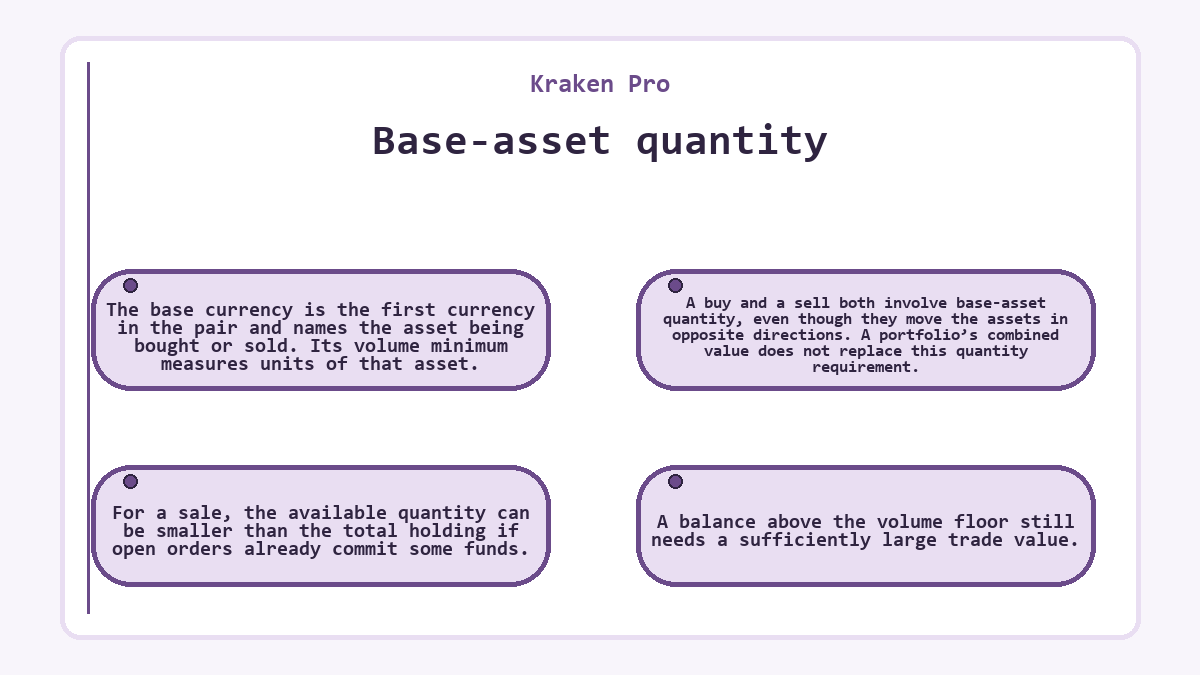
Base-asset quantity
The base currency is the first currency in the pair and names the asset being bought or sold. Its volume minimum measures units of that asset. A buy and a sell both involve base-asset quantity, even though they move the assets in opposite directions. A portfolio’s combined value does not replace this quantity requirement. For a sale, the available quantity can be smaller than the total holding if open orders already commit some funds. A balance above the volume floor still needs a sufficiently large trade value.
Quote-currency trade value
The quote currency is the second currency in the pair and expresses the trade’s value. For a limit order, multiplying base quantity by limit price gives the proposed quote-currency cost. Here, price means quote units per base unit. The cost minimum tests this trade value; trading fees remain a separate charge.
At a specified limit price, the quantity must be at least the larger of the volume floor and the cost floor divided by that price, with any upward adjustment staying within the market’s permitted quantity increments. A lower limit price can therefore require more base units to reach the same cost floor, even when the asset’s volume minimum has not changed.
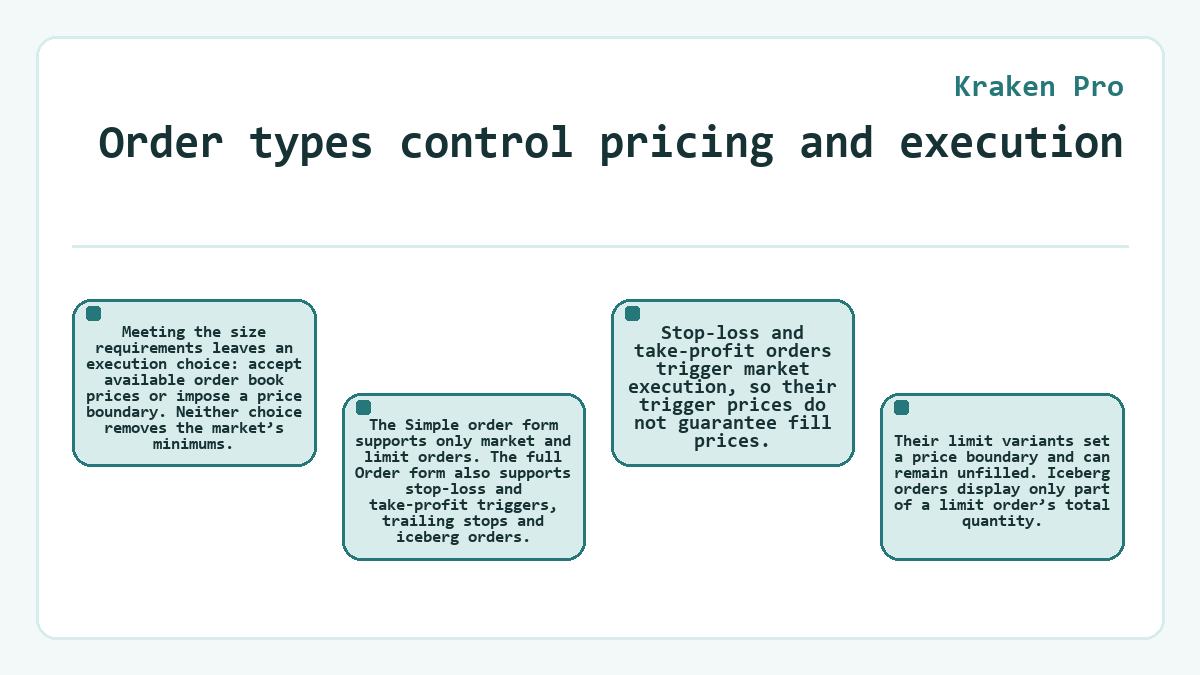
Order types control pricing and execution
Meeting the size requirements leaves an execution choice: accept available order book prices or impose a price boundary. Neither choice removes the market’s minimums. The Simple order form supports only market and limit orders. The full Order form also supports stop-loss and take-profit triggers, trailing stops and iceberg orders. Stop-loss and take-profit orders trigger market execution, so their trigger prices do not guarantee fill prices. Their limit variants set a price boundary and can remain unfilled. Iceberg orders display only part of a limit order’s total quantity.
Buying or selling at available prices
A market order seeks immediate execution against available orders in the book. Its execution price can differ from the last traded price that appears on a chart. Multiple fills can also occur at different prices. For a market order sized in base units, final spending or proceeds depend on the actual fill prices. The applicable taker fee adds another cost input.
Setting a limit price
A limit order defines the worst acceptable execution price, although matching may provide a better price. It can remain unfilled or fill partly. An ordinary limit order that immediately matches existing liquidity can incur taker fees. Maker treatment depends on adding liquidity; selecting “limit” alone does not establish the fee category.
Why can an order fail when the balance looks sufficient?
An order can fail because funds are committed elsewhere or the available balance lacks the currency required for that trade. The account’s total portfolio value combines holdings that are not automatically interchangeable. A spot buy spends the selected pair’s quote currency. A spot sell draws on its base asset. Open orders can tie up the funds needed for either direction.
Fees introduce a separate balance consideration. A buy funded from quote currency needs to accommodate any trading fee charged against that balance. The order form’s estimated fee helps distinguish the proposed exchange value from this additional debit. Where fee-currency selection is available, it expresses a preference that the platform may not honor if the necessary balance is unavailable.
The applicable fee schedule, account tier and maker-or-taker execution determine the rate. Standard crypto fee tiers use the best qualifying measure from eligible spot volume, eligible futures volume or Assets on Platform. Trading volume uses a rolling assessment window; Assets on Platform uses the current value of eligible holdings. Instant Buy purchases, conversions and trades on the stablecoin/FX schedule do not count toward qualifying spot volume. Futures-based tier qualification has regional exclusions. Use the current fee schedule for your account and market. Changing the fee currency changes the units of the charge; the percentage still measures a proportion of executed trade value. A lower rate does not waive the order minimum or supply missing funds.
Checking whether a limit buy fits the budget
Proceed only if the smallest permitted order fits the amount that you intend to spend. For an ordinary spot limit buy, the quantity and price fields establish proposed trade value, while the fee estimate supplies an additional cost input. Use the actual selected market and account figures for this decision. An attractive fee rate alone cannot establish affordability.
- If quantity falls below the base-asset floor, the proposed order is too small.
- If quantity times limit price falls below the quote-currency floor, the trade value is insufficient.
- If price or quantity violates permitted increments, revise the affected field within the intended budget.
- If available quote funds cannot cover the trade and applicable fee debit, defer submission or reconsider the quantity.
- If the valid minimum exceeds the intended spending amount, leave the order unsubmitted.
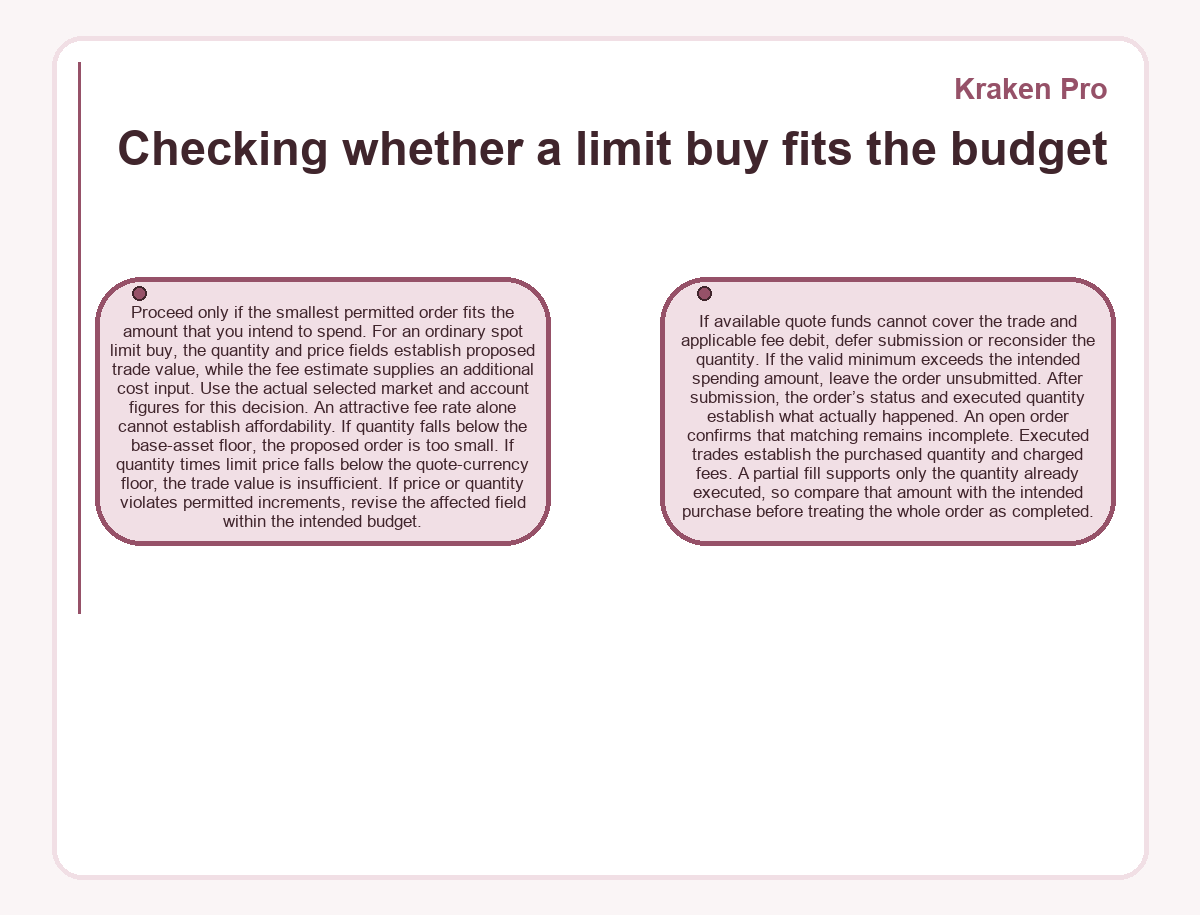
After submission, the order’s status and executed quantity establish what actually happened. An open order confirms that matching remains incomplete. Executed trades establish the purchased quantity and charged fees. A partial fill supports only the quantity already executed, so compare that amount with the intended purchase before treating the whole order as completed.
Decimal precision can block an otherwise large enough order
A quantity above the volume floor can still be invalid if its decimal precision exceeds the market’s allowance. Price increments constrain limit prices independently. The minimum quantity answers how small an order may be; the increment answers which quantities the market accepts. Adding decimal places does not create a smaller permitted trading step.
Automated spot trading needs parameters for the selected market because precision and minimums can differ across markets.
The REST AssetPairs response includes ordermin, costmin and precision information.
The spot WebSocket v2 instrument feed reports minimum order quantity in the base currency.
Its qty_min, cost_min, qty_increment and price_increment fields distinguish size floors from permitted steps. These values belong to the selected market. Refreshing market parameters matters when the exchange changes its trading requirements.
Small balances, funding and leveraged trading
A holding below the spot order floor may fit a different transaction type with its own requirements. Instant buying uses separate minimums and quote-based charges. Kraken Pro web also has a small-balance conversion feature. That feature carries its own fee and timing restriction, so conversion eligibility should be considered separately from the rejected order’s size.
Deposit and withdrawal minimums govern moving funds, while trading minimums govern an exchange within the account. A credited deposit can still leave too little available for a particular order. Margin trading adds eligibility, collateral and funding conditions to the sizing decision. Using extended funds can add charges for opening and maintaining a position. Leveraged positions can be liquidated when collateral no longer meets their margin requirements. Kraken Pro also supports derivatives trading for eligible clients, where contracts provide price exposure without purchasing the underlying asset. Those products have separate margin and fee rules, and availability depends on jurisdiction and account eligibility. The applicable requirements change with the selected market and transaction type; a spot minimum does not describe every service in the account.
Kraken Pro: common questions
Does a successful API validation place a live spot order?
A successful validation-only API request does not place an order for execution. The spot REST API’s validate option checks the request without trading in the matching engine. A later live request remains a separate submission, and changing market or account conditions can affect whether it succeeds.
Can an API market buy specify its size in quote currency?
The spot REST API supports quote-currency sizing for non-margin market buy orders through the viqc flag. This expresses order volume in the currency being spent. The flag does not apply to market sells, limit orders or orders using margin. It also does not waive the selected market’s trading requirements or establish the quantity that will ultimately be acquired.
Are minimum trading fees the same as minimum order sizes?
A minimum trading fee and a minimum order size constrain different amounts. The order minimum governs the quantity or value needed for an acceptable order. Fee precision can establish a smallest fee amount that the system can record, affecting very small trades. That fee requirement remains separate from both the base-asset volume floor and the quote-currency cost floor.
Will cancelling an unfilled spot order incur a trading fee?
Cancelling a spot order that has never executed does not incur a trading fee. If part of the order has already filled, the executed portion has its applicable trading fees. Cancelling the remaining quantity does not undo those trades.
Which balances qualify for small-balance conversion?
Small-balance conversion covers crypto balances below the instant buy or sell minimum. That eligibility threshold differs from a selected spot market’s volume floor. A balance too small for a Pro spot order does not automatically qualify for conversion. The feature applies its own conversion fee and interval restriction, which are separate from ordinary order book trading fees.